

Adwords Ad Rank Formula – How It Could Impact Your Business
In late October, Google (very quietly) announced a change to its Ad Rank algorithm, one which could impact many small businesses if they don’t understand it properly.
So why would Google make this change? And how could it affect the typical small business owner? Let’s have a look.
Firstly: What Is Ad Rank Anyway?
Ad Rank is the Paid Search equivalent to the more notorious algorithm Google uses to rank sites in their organic search results. However, Ad Rank doesn’t just determine what position an advert appears in the sponsored search results, Google also uses Ad Rank to work out how much the advertiser pays when someone clicks on their advert. Unlike it’s more famous twin, the Organic Search algorithm, Google has always been very open & upfront with how Ad Rank is calculated. In fact, up until October they have been using the same formula years. This was their Ad Rank equation prior to October:
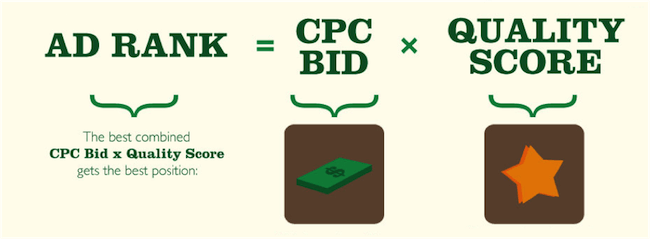
So if a business was trying to improve their Adwords ad rank, they just needed to concentrate on improving one or both of the following:
- Increase your keyword bids — Businesses willing to pay more on a Cost Per Click (CPC) basis had an advantage, but this often came at the expense of quality and relevance.
- Improve your Quality Score (QS) — Google likes to see demonstrated ad relevance. So the more relevant your advert or keyword, the higher the ranking you can obtain at a lower cost.
Ok, So How Has Ad Rank Changed?
The new Ad Rank formula is now made up on three elements, instead of two. Google will still be concerned with your CPC bid and Quality Score, but now your Ad Rank also takes into account “the expected impact from your ad extensions and formats.” To translate, basically your Ad Rank will improve, as you use more fancy features and ad formats within Adwords.
So, if you’re only using the most basic, default ad types, without any additional features, you’re not necessarily going to be able to rank in the top spots, even if your Quality Score and bids are strong.
Why Are Ad Extensions Important?
An ad extension is an option in AdWords that allows you to expand your ad with additional information, such as your phone number, your location and links back to your site. The most basic form of ad extension is the sitelink. Ads with sitelinks enabled look like this:
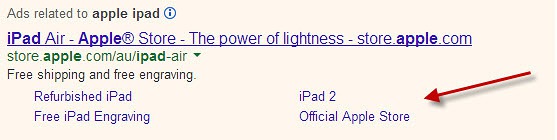
Where you see the extra blue links at the bottom of the ad (“iPad2,” “Refurbished iPad,” etc.) are sitelinks. Obviously your sitelinks can be customised to your website & can highlight the most relevant pages of your website for the keywords used in the search. However ad extensions don’t stop with sitelinks. As mentioned before there are lots of other ad extensions too — image extensions, location extensions, click-to-call extensions for mobile ads, and so on. Each one is customised to your website and your AdWords Campaigns, each Campaign having it’s own set of extensions available to it.
Why Has Google Changed Its Ad Rank Algorithm?
Well Google loves it when businesses use sitelinks and other ad extensions because it’s been proven to dramatically increase an adverts clickthrough rate (CTR), and of course the more clicks your advert gets, the more money in Googles pocket ! But don’t get me wrong, higher CTRs are good for businesses like you too, because in turn they increase your keyword & adverts Quality Score, which in turn improves your adverts rankings and makes them cheaper, which improves your ROI.
Ok, But What Does this Ad Rank Change Mean for You?
Well, realistically, you should be using ad extensions already. They’re free to set up and one of the easiest ways to improve ad performance!
But in reality small and medium sized business have been slow to take ad extensions up, simply because they tend to be time poor and in all fairness have less PPC expertise. On the flip side, many small & medium businesses also outsource their Adwords Account Management to Agencies. Unfortunately some unscrupulous Agencies often ‘own’ the Adwords accounts under their own company name, because this way they control the account and when a client leaves their services the client loses all of the Adwords information they have been paying for.  Think of it as a ‘carrot on a stick’ method of making clients stay with them for longer.
This change will impact those companies & their clients a great deal, since many of these agencies do not use ad extensions because it is very difficult to manage multiple ad extensions for hundreds of clients. So if your business outsources your Adwords Account be sure to question your agency as to who ‘owns’ the Adwords Account.
The other group of small businesses that will be affected but may not realise it, are franchises or businesses whose internet marketing activities are controlled by ‘Head Office’. Again, if Adwords campaigns are being run nationwide for many different office or retail locations, then ad extensions specific to each location, also become impossible.
There is no doubt in my mind that Google is drawing a line in the sand with this latest change. Its message? Use ad extensions or else! They’re not really an option anymore — if you’re advertising on AdWords, you need to start using extensions ASAP. Otherwise, your competitors are going to take the top spots, and your PPC performance is going to suffer.
If you’re unsure if your business is using ad extensions, or if you’re using them properly, contact us and we’d be happy to check it out for you for free.


Comments
No comment yet.